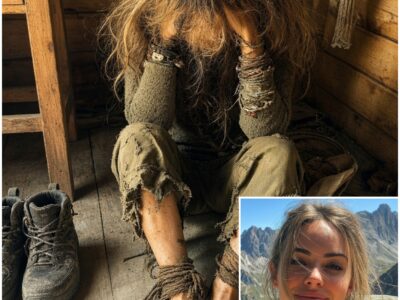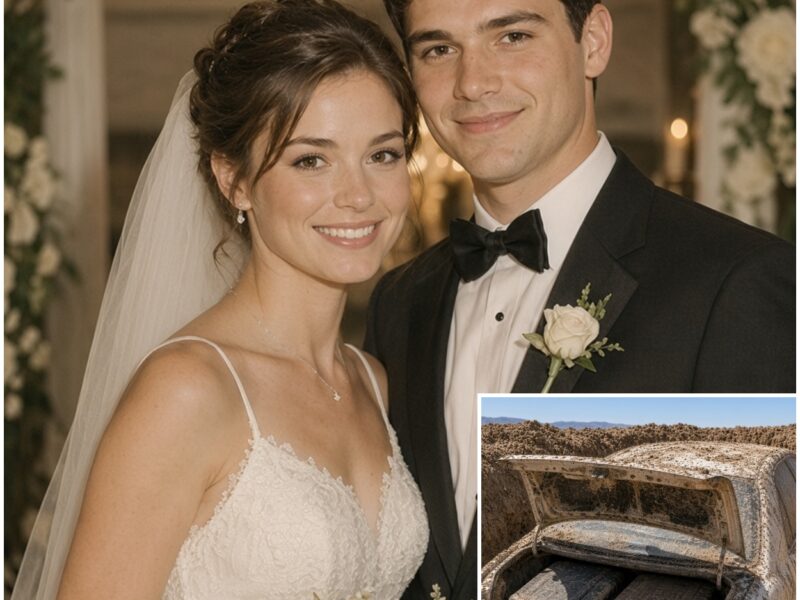
A Couple Vanished On Their Way To Their Honeymoon — 25 Years Later, Their Buried Car Was Found
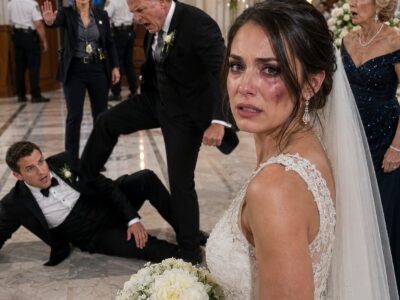
In September 1999, Rachel Donovan and Ethan Caldwell were preparing to begin married life in Henderson, Nevada.
Rachel was 24 and taught second grade in the Las Vegas Valley.
Ethan was 27, a software engineer and co-founder of a young technology company called Silver Ridge Systems.
Their wedding brought together relatives, college friends, co-workers, and people who had known them before their lives became connected.
The reception ended late that evening.
Rachel had already changed into travel clothes.
Their luggage was packed, and they planned to drive directly to McCarran International Airport for an overnight flight to Honolulu.
At approximately 9:40 p.m., their white sedan left Henderson.
They never arrived at the airport.
By the following afternoon, the absence could no longer be explained by a missed call or a delayed flight.
The airline confirmed that neither Rachel nor Ethan had boarded.
Their honeymoon reservation remained unused.
No new financial activity appeared in either account.
There was no later record of their passports being used.
Las Vegas police opened a missing person investigation and reconstructed the expected route from Henderson to the airport.
Wedding guests, relatives, friends, co-workers, and employees at Silver Ridge Systems were interviewed.
Hospitals and accident reports were checked.
Authorities looked for the sedan throughout the region.
Nothing appeared.
The car was not found abandoned.
There was no confirmed crash and no evidence that Rachel and Ethan had deliberately changed their plans.
Their luggage had disappeared with them, leaving investigators with almost no physical evidence to follow.
Rachel’s younger sister, Megan Donovan, was 19 at the time.
She had expected the disappearance to be resolved quickly because there seemed to be only a limited number of places the couple could have gone between the reception and the airport.
Instead, the investigation stretched from days into months and then years.
As the case grew older, the family kept every piece of information that might someday matter.
Wedding photographs, printed emails, guest lists, travel records, police correspondence, and news clippings were preserved.
Rachel and Megan’s mother remained convinced that her daughter might still be alive somewhere, even when new leads became increasingly rare.
The case never produced a confirmed explanation.
25 years later, in September 2024, a highway expansion project south of Las Vegas changed that.
Construction workers encountered a large object beneath compacted ground in an area that had remained undisturbed for decades.
Work stopped immediately, and law enforcement was called after the object was identified as a vehicle.
Once investigators exposed enough of it to examine registration in formation, the connection was confirmed.
It was Ethan Caldwell’s white sedan.
The discovery transferred the old case to Detective Daniel Reeves of the Las Vegas Metropolitan Police Department’s Cold Case Unit.
Unlike investigators in 1999, Reeves had access to modern DNA analysis, improved forensic testing, digitized records, and databases capable of connecting evidence across states.
Even so, the first question was simple.
What was inside the car? The answer was not what anyone had expected.
There were no human remains.
The trunk still contained two old suitcases and clothing belonging to Rachel and Ethan.
Investigators also recovered one of Rachel’s shoes, several areas containing dried blood, and a damaged sheet of paper covered with handwritten number sequences.
The condition of the vehicle made every item important.
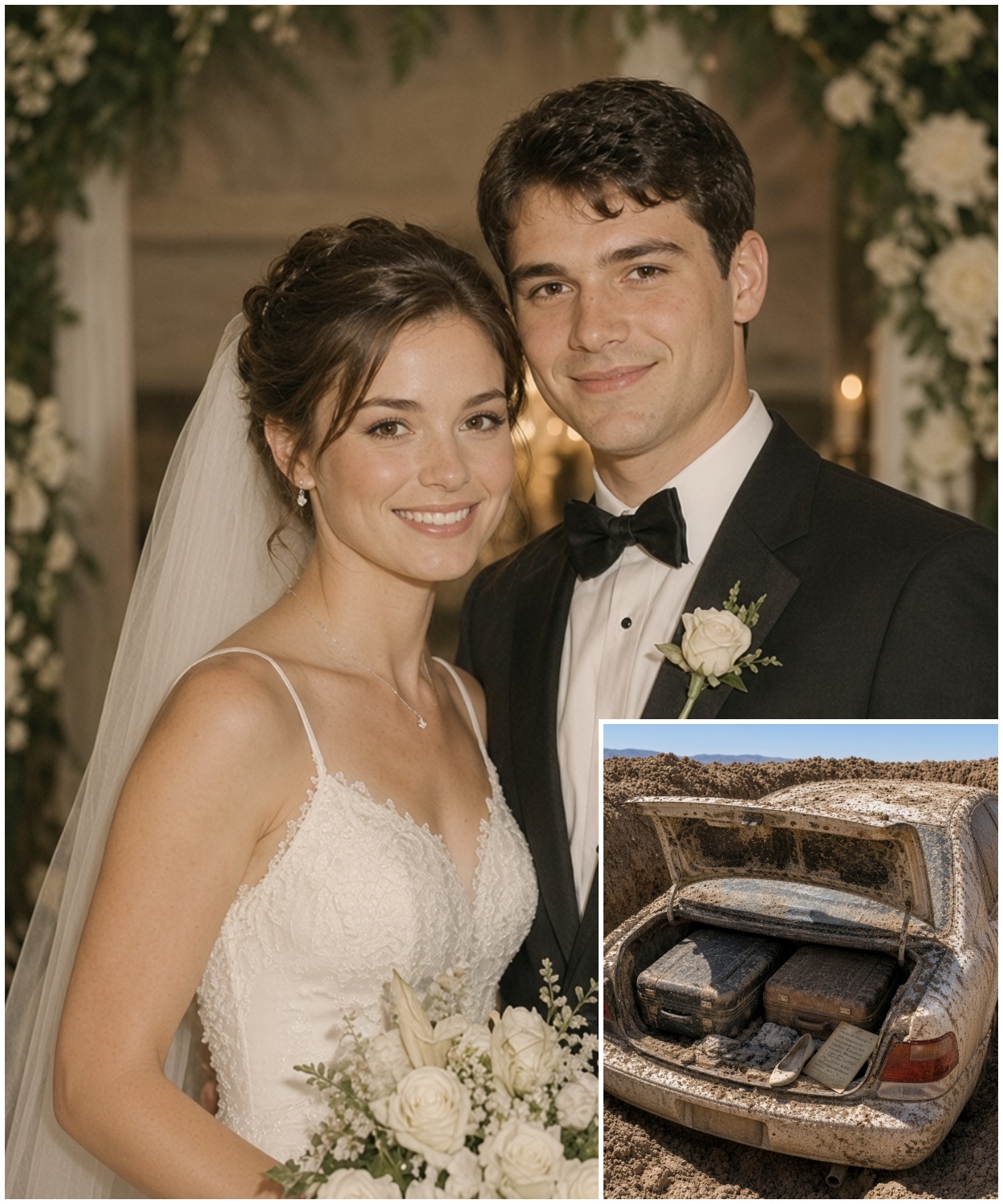
Forensic testing established that the blood had been there for decades, but the amount did not support the conclusion that either person had died inside the sedan.
There was evidence that something violent might have happened.
Yet the car itself contained no proof that Rachel or Ethan had been killed.
That distinction reopened possibilities the family had almost stopped considering.
The handwritten numbers became another point of interest.
They did not appear to be dates, phone numbers, or ordinary personal notes.
Reeves ordered them preserved for comparison with old business and financial records connected to Ethan.
For the first time since 1999, the investigation had physical evidence that could be tested rather than memories that could only be revisited.
Megan was informed soon after the vehicle was identified.
For 25 years, her family had lived with uncertainty because there had been no car, no bodies, and no reliable indication of where Rachel and Ethan had gone.
Finding the sedan did not solve the disappearance, but it removed one assumption that had quietly shaped the case for decades.
The car had been deliberately hidden.
Rachel and Ethan were not inside it.
Whatever had happened after they left their wedding reception, the evidence now suggested that their story had continued beyond the place where someone had tried to erase it.
The buried sedan gave Detective Daniel Reeves his first physical link to the 1999 disappearance, but the damaged sheet of handwritten numbers gave him something even more useful.
A reason to examine Ethan Caldwell’s business life.
Analysts compared the surviving number sequences with old Silver Ridge Systems records and found that several matched internal accounting references and storage identifiers once used by the company.
That connection immediately shifted the investigation away from the airport route and toward a conflict that had been developing before Rachel Donovan and Ethan vanished.
Silver Ridge Systems had been founded in 1997 by Ethan and his college friend Jason Whitaker.
At the time, the company was still small but growing quickly, developing management software for local businesses in the Las Vegas area.
Ethan and Jason owned equal shares and both were involved in the company’s financial decisions.
By early 1999, that arrangement had begun to break down.
Archived records showed a series of withdrawals and transfers from company accounts that Ethan had not approved.
The total eventually approached $200,000.
An amount large enough to threaten both the company and the people responsible for moving it.
The transactions led back to Jason.
Ethan had already started documenting the irregularities months before the wedding.
Old legal records showed that he was preparing to end the partnership and intended to take the financial evidence to an attorney after returning from Hawaii.
That made the timing impossible to ignore.
If Ethan followed through, Jason could lose his ownership position, face civil claims, and potentially become the subject of a criminal investigation.
Reeves and investigator Lauren Mitchell then reviewed Jason’s personal finances from the same period.
Those records exposed another source of pressure.
Jason had been gambling heavily.
Several transactions were tied to private poker games operating outside ordinary casinos.
The games were connected to Vincent Moretti, a Las Vegas businessman whose name had appeared in law enforcement files during the late 1990s.
Moretti had never been convicted of a major violent crime, but investigators had associated him with illegal lending, private gambling, and aggressive collection practices.
Jason owed him money.
The exact amount could not be reconstructed from every surviving record, but the debt was substantial.
It existed at the same time Ethan was preparing to expose nearly $200,000 in unauthorized company withdrawals.
The overlap gave Reeves a clearer picture of Jason’s position in 1999.
He was not facing one problem.
He was facing several at once.
The company money was missing.
Ethan had discovered it.
The partnership was about to collapse.
Legal consequences were possible.
Private gambling debts were still unresolved.
Then Ethan disappeared.
The company did not.
Silver Ridge continued operating under Jason’s control.
Over the following years, the business expanded, acquired larger clients, and became far more valuable than it had been in 1999.
After the legal process surrounding Ethan’s prolonged disappearance, Jason eventually gained effective control over the company.
By 2024, Silver Ridge Systems was worth tens of millions of dollars.
That did not prove Jason had caused the disappearance, but it established that Ethan’s absence had changed Jason’s future in a dramatic way.
Reeves returned to the handwritten numbers from the buried car.
Additional analysis showed that some of them corresponded to backup references used by Silver Ridge before the company modernized its systems.
Investigators found evidence that Ethan had created a duplicate set of financial records shortly before the wedding.
He had not simply noticed suspicious transactions.
He had preserved proof of them.
The complete backup had not yet been located, but its existence meant Ethan had been preparing for more than an argument with his business partner.
He was creating a record that could survive even if information inside the company disappeared.
Jason was brought in for questioning again.
He admitted that he had taken money from Silver Ridge accounts and acknowledged that gambling had affected his judgment during that period.
He described the missing funds as reckless financial decisions, rather than a deliberate plan to steal from the company.
He also admitted that he had known Vincent Moretti through private poker games.
What Jason would not admit was any knowledge of what happened to Rachel and Ethan after the wedding.
He insisted that the financial dispute had nothing to do with their disappearance.
Investigators still did not have enough evidence to arrest him.
There was no witness placing Jason with the couple after they left Henderson.
There was no confirmed crime scene.
There was no proof showing how Ethan’s car had reached the desert.
But the case had changed again.
Before the sedan was found, investigators had only a disappearance.
Now they had a buried vehicle, financial records showing a serious conflict, gambling debts tied to Vincent Moretti, and evidence that Ethan had secured documents capable of exposing Jason.
For the first time, the mystery had a motive strong enough to explain why someone might have wanted Ethan removed from Silver Ridge before he ever returned from his honeymoon.
The financial records gave investigators a reason to focus on Jason Whitaker.
But they still lacked evidence showing what had happened to Rachel Donovan and Ethan Caldwell after they left Henderson.
That changed when forensic analysts finished examining the clothing recovered from the buried sedan.
Several fibers embedded in the fabric came from industrial carpeting commonly used in office and warehouse spaces during the late 1990s.
They did not match anything inside Ethan’s car.
Detective Daniel Reeves and investigator Lauren Mitchell compared the material with properties once used by Silver Ridge Systems and found a strong lead.
From 1997 into the early 2000s, the company had rented a warehouse in North Las Vegas.
The building had changed owners several times, and most of the original interior had been replaced.
Even so, investigators obtained a warrant because enough of the old structure remained to justify a forensic search.
Testing beneath the former office area produced the the major result.
Traces of old blood were found in the concrete.
DNA analysis identified Ethan Caldwell.
The finding established that Ethan had been inside the warehouse after leaving the wedding reception and that he had suffered a significant injury there.
The amount of blood was serious, but it did not support the conclusion that he had died.
Investigators also found marks consistent with restraint hardware having been used in the building.
Near the former loading area, surviving surface patterns suggested that a larger vehicle had been present around the same period.
An archived repair invoice from late September 1999 documented damage to one of the warehouse doors shortly after Rachel and Ethan vanished.
For Reeves, the evidence created a much more precise sequence.
The couple had not simply disappeared somewhere between the reception and the airport.
At some point that night, they had been taken to a property connected directly to Ethan’s company.
Before narrowing the case further, investigators revisited another person from Rachel’s past.
Michael Hayes had dated her before she met Ethan.
Their breakup had been difficult, and phone records from 1999 showed that Michael contacted Rachel repeatedly during the week before the wedding.
He had also been in Nevada on the night she disappeared.
Those facts had never been enough to identify him as a serious suspect in the original investigation, but the reopened case required every unexplained connection to be tested.
Financial records showed that Michael had withdrawn a noticeable amount of cash around the same period.
Reeves and Mitchell also discovered that his original account of where he had been that night contained gaps.
The uncertainty lasted until investigators located Natalie Brooks.
Natalie had been involved with Michael privately in 1999.
She confirmed that he had been with her during the critical hours, and surviving hotel records and payment information supported her account.
The unusual cash transactions were connected to that relationship rather than to Rachel’s disappearance.
Michael was removed from the main investigative path.
That left the evidence pointing back towards Silver Ridge.
Jason had a clear financial motive.
Ethan’s blood had been found inside the company warehouse.
Jason had also admitted that his gambling debts connected him to Vincent Moretti.
Reeves and Mitchell questioned Jason again, this time with the warehouse evidence.
Jason acknowledged that Ethan regularly used the property in 1999.
He also repeated his earlier admission that he had taken money from the company and had been under pressure because of gambling.
What he continued to deny was any knowledge of why Ethan’s blood was in the building or what happened to Rachel after the reception.
He described the warehouse as an ordinary workplace and claimed the blood could have come from some earlier accident.
The forensic evidence did not support that explanation well enough to resolve the issue, but it still was not enough for an arrest.
Investigators had no witness placing Jason with Rachel and Ethan that night.
They had no reliable entry records from the warehouse.
They did not know who had transported the couple there or who had later moved Ethan’s sedan into the desert.
The case remained incomplete, but it was no longer directionless.
The warehouse established a physical connection that the original investigation had never found.
Ethan had been there.
He had been injured there.
The evidence suggested that someone had controlled what happened inside and then removed the couple afterward.
For 25 years, police had treated the airport route as the place where Rachel and Ethan disappeared.
Now Reeves understood that the real disappearance had begun somewhere else entirely.
It had begun inside Silver Ridge Systems.
Megan Donovan had kept nearly everything connected to Rachel’s wedding because no one in the family had ever received an explanation strong enough to make the case feel finished.
In 2024, those old records became useful again.
After Detective Daniel Reeves confirmed that Ethan Caldwell’s blood had been found inside the former Silver Ridge warehouse, Megan reviewed the wedding materials with more attention to names and business connections.
One entry on the guest list immediately stood out.
Thomas Moretti.
Megan remembered little about him personally, but the surname was now impossible to ignore.
Thomas, known as Tom, was the nephew of Vincent Moretti, the same man connected to Jason Whitaker’s gambling debts.
Lauren Mitchell pulled employment records from the late 1990s and found a second connection.
Tom had worked for Silver Ridge Systems from 1997 through 2000.
He had been young at the time, employed in a technical role, and had regular access to company property.
That meant he knew Ethan, knew Jason, and could enter the North Las Vegas warehouse where Ethan’s blood had been found.
The connection was stronger than investigators expected.
Megan also found a printed email from several weeks before the wedding.
Tom had contacted Ethan about arrangements connected to the pre-wedding gathering, confirming that their relationship extended beyond casual workplace contact.
Reeves now had someone who linked Vincent Moretti directly to Ethan’s company and to the property at the center of the investigation.
At the same time, investigators began searching medical records from the days immediately after September 18th, 1999.
If Ethan had been seriously injured in the warehouse, but had not died there, then there was a reasonable chance he had received medical treatment somewhere outside Las Vegas.
Rachel’s missing remains created the same possibility.
The search expanded through Nevada and into neighboring states.
Hospitals, urgent care centers, clinics, unidentified patient records, and archived admissions were reviewed wherever records from 1999 still existed.
The first significant match came from Kingman, Arizona.
A small clinic had treated an unidentified woman in her mid-20s several days after Rachel disappeared.
The patient had no reliable identification and gave limited personal information.
The surviving medical notes documented to the wrist and several physical characteristics that closely matched Rachel.
The file had never been connected to the Las Vegas investigation.
The timing was difficult to dismiss.
Reeves requested every surviving record from the visit, but the documentation was incomplete.
There was not enough information for a formal identification.
Then Lauren found another case.
A hospital in St.
George, Utah, had admitted an unidentified man in his late 20s during the same general period.
He had suffered a significant head injury and showed serious problems with memory.
The intake notes indicated that he could not provide a complete personal history or reliable identifying information.
One archived photograph still existed.
It was not enough to establish identity on its own, but the similarities to Ethan were strong enough to move the record into the center of the investigation.
The medical files created a possibility that had not existed before.
Rachel may have reached Kingman alive.
Ethan may have reached St.
George alive.
The locations also introduced a new problem.
They were in different states.
If the records belonged to Rachel and Ethan, then the couple had not simply run away together.
They had survived the same disappearance and then somehow ended up hundreds of miles apart.
That distinction changed the direction of the case.
Investigators no longer needed to explain why two newlyweds would voluntarily abandon their families, careers, and honeymoon plans.
The evidence increasingly suggested that someone else had controlled where they went after leaving the warehouse.
Tom Moretti became more important with every new finding.
His employment records placed him inside Silver Ridge during the exact years relevant to the case.
The wedding documents proved he knew Ethan personally.
His relationship with Vincent connected him to the man already associated with Jason’s financial problems.
By 2024, Tom had left the technology industry and spent years working inside businesses connected to the Moretti family.
Reeves and Mitchell prepared to question him formally.
They also sought legal authority to obtain a DNA sample.
For the first time, investigators had identified a person who did more than share a motive, a debt, or an indirect connection.
Tom had access to the warehouse.
He knew the people involved.
And if the medical records were what they appeared to be, he might also know how Rachel Donovan and Ethan Caldwell left Nevada alive and ended up in two different states.
By the time Thomas Moretti was formally questioned in 2024, Detective Daniel Reeves and Investigator Lauren Mitchell had enough evidence to place him at the center of the old Silver Ridge network.
Tom had worked for the company in 1999, knew Ethan Caldwell personally, attended Rachel Donovan and Ethan’s wedding, had access to the North Las Vegas warehouse, and was the nephew of Vincent Moretti.
The medical records from Kingman and St.
George had added another layer of pressure.
If those unidentified patients were Rachel and Ethan, then both had survived the night they disappeared.
Tom could no longer treat the case as a forgotten event from his 20s.
He agreed to cooperate after prosecutors made clear that his role would be evaluated according to what he had done and how much truthful information he could provide.
His account finally explained the chain of events that began before the wedding.
Jason Whittaker had been desperate.
Ethan had discovered nearly $200,000 missing from Silver Ridge accounts and was preparing to end their business partnership.
He also intended to take the financial records to an attorney after returning from Hawaii.
At the same time, Jason was carrying private gambling debt connected to Vincent Moretti.
Jason believed that if Ethan moved forward, he could lose the company, face legal consequences, and still owe money he could not easily repay.
He went to Vincent for help.
According to Tom, the original plan was not murder.
Jason wanted Ethan pressured into surrendering the financial records and walking away from Silver Ridge.
Vincent agreed to handle it.
On September 18th, 1999, Jason contacted Ethan on the day of the wedding and claimed there had been a break-in at the North Las Vegas warehouse.
He suggested that important company information might have been compromised.
Because Ethan was still responsible for Silver Ridge, he agreed to stop there briefly before going to McCarran International Airport.
Rachel remained with him because they were already traveling together for their overnight flight.
Vincent and Tom were waiting at the warehouse.
Jason’s goal was to force Ethan to give up the evidence and abandon his claim to the company.
Ethan refused.
During the confrontation, he suffered a serious head injury.
Rachel was also injured around one wrist while being restrained.
The situation changed again when Vincent learned that Ethan had already created a backup copy of the financial records outside the company’s main system.
Taking documents from the warehouse would no longer solve Jason’s problem.
Keeping Rachel and Ethan in Las Vegas would create even greater risk.
Vincent decided that they needed to disappear, not die.
Disappear.
Ethan’s white sedan was removed from the warehouse with the couple’s luggage and personal belongings still inside.
The vehicle was later taken into the desert south of Las Vegas and buried.
The purpose was simple.
If the car vanished with the couple, investigators would have no clear crime scene and no obvious reason to connect the disappearance to Silver Ridge.
Rachel and Ethan were then separated.
Rachel was transported toward Arizona and eventually left near Kingman.
Before she was released, she was warned that returning to Las Vegas or contacting her family could put Megan and their mother in danger.
The threat was intended to control her long after she was physically free.
Rachel had no way to know whether Ethan was still being held.
Ethan was taken in another direction.
His head injury had already caused severe confusion and memory problems.
He was eventually left near St.
George, Utah, without the documents that would have immediately established who he was.
Tom’s account matched the medical evidence investigators had already found.
The woman treated in Kingman had the same type of wrist injury Rachel suffered.
The unidentified man treated in St.
George had a serious head injury and could not provide a reliable personal history.
The pieces finally fit without requiring investigators to assume either person had died.
Rachel had survived, but believed returning home could endanger the people she loved.
Ethan had survived, but no longer possessed a complete understanding of his own identity.
Their separation was not voluntary.
It had been designed.
For 25 years, the case had looked like the disappearance of a married couple.
Tom’s statement revealed something very different.
Rachel and Ethan had been forced onto separate paths before the night was over.
And the people responsible had depended on fear, injury, and distance to make sure those paths never crossed again.
Once Thomas Moretti’s statement was matched against the old medical records, Detective Daniel Reeves and Investigator Lauren Mitchell stopped treating Rachel Donovan and Ethan Caldwell as people who had simply vanished.
The investigation now had a different purpose.
Find out what happened to each of them after they were separated in 1999.
They began with Ethan.
The hospital file from St.
George, Utah, contained enough information to reconstruct part of his life after the head injury.
Ethan had arrived without reliable identification and with serious memory problems.
He could remember practical skills more easily than personal details, which made it possible for him to function even while large parts of his past remained inaccessible.
After treatment, he received help through local support services that assisted people without stable housing, clear documentation, or family contacts.
Over time, he recovered enough independence to work again.
Technology remained familiar to him.
He began with basic computer repair, then took more stable technical jobs.
Eventually, he moved to Fort Collins, Colorado, where he built a quiet career in system support for a small company.
His adult life became organized and predictable, but the years before Utah never fully returned.
Ethan never married.
Among the few belongings he continued to keep was a wedding ring.
He understood what it meant in general, but he could not connect it to a complete memory of the woman he had once married.
Rachel’s trail was harder to follow.
The clinic record in Kingman, Arizona, showed that she had received treatment for the wrist injury soon after the disappearance.
What came next had been shaped almost entirely by fear.
Vincent Moretti’s warning had convinced her that contacting Megan or their mother could expose them to danger.
Rachel had no way to know whether the threat was still active, whether Ethan was alive, or whether anyone connected to Vincent was watching for her return.
For years, she avoided rebuilding the life she had left behind.
She relied on temporary work and kept her personal history private.
Eventually, she moved north and settled in Eugene, Oregon.
There, Rachel found work with organizations that supported children and families dealing with unstable housing, domestic crises, and sudden displacement.
The work gave structure to a life that had been interrupted without giving her back what she had lost.
She never remarried.
Unlike Ethan, Rachel remembered exactly who she was.
What she did not know was whether returning to her old identity would ever be safe.
She kept one small wedding photograph from 1999.
By October 2024, investigators had enough information to move from historical records to living people.
Ethan was located first.
The result was conclusive.
The man living in Colorado was Ethan Caldwell.
For the first time, the case no longer depended on possibility.
Ethan had survived.
The search for Rachel moved faster after that confirmation.
Public records, employment history, and information connected to the Kingman Clinic eventually led investigators to Eugene.
Rachel was 49 years old.
Her DNA was compared with family reference material preserved through the investigation.
It matched.
Rachel Donovan had also survived.
For Megan, the confirmation changed the meaning of everything the family had believed for 25 years.
Rachel had not chosen to disappear.
Ethan had not abandoned his wife.
Their lives had continued separately because one had been controlled by fear and the other by injury.
Reeves understood that finding them was only the beginning of a more difficult process.
Neither person could simply return to September 1999.
Too much time had passed.
Too many relationships and ordinary years had been lost.
And both had built lives shaped by circumstances they never chose.
But the investigation had finally reached something the original detectives never had.
Two verified identities.
Two living people.
One crime that had succeeded for 25 years only because Rachel and Ethan had been kept apart long enough for the world to stop expecting either of them to return.
By late October 2024, the investigation had reached a point no one in the Donovan or Caldwell families had expected to see.
Rachel Donovan had been identified in Oregon.
Ethan Caldwell had been identified in Colorado.
Both were alive and for the first time in 25 years, the case was no longer about where they had disappeared.
It was about bringing them back into the truth.
Megan Donovan received confirmation about Rachel first.
For most of her adult life, she had carried her sister’s absence as an unresolved part of the family.
She had built a life, raised a daughter, preserved the old wedding records, and continued answering questions whenever investigators revisited the case.
Now Rachel was coming back to Nevada.
The reunion gave the family something they had never believed they would receive.
But it also forced Rachel to confront what 25 years had taken from her.
The most painful loss was their mother.
She had died several years earlier after spending decades refusing to believe Rachel was gone forever.
She had kept photographs, letters, wedding documents, and every update from police because she continued to hope that one day her daughter would return.
Rachel had lived with the opposite fear.
Vincent Moretti’s threat had convinced her that contacting Megan or their mother could place them in danger.
That fear had shaped years of silence and distance.
Learning that her mother had died without knowing the truth became the one part of the return that no investigation could repair.
Then Detective Daniel Reeves gave Rachel another answer.
Ethan was alive.
That information changed the meaning of her past again.
Rachel had never known what happened to him after they were separated.
She had spent years believing he might still be under the control of the people who took them or that something worse had happened after she was left near Kingman.
Ethan had lived with a different kind of absence.
His head injury had damaged much of his personal memory leaving him with fragments instead of a complete history.
He had built a stable life in Colorado without understanding why certain images, technical habits, and one wedding ring remained connected to a past he could not fully reach.
Reeves arranged for Rachel and Ethan to meet in Las Vegas with support from family members and trauma specialists.
They were not the same people they had been in 1999.
Ethan was 52.
Rachel was 49.
They had spent more years apart than they had ever spent together before their wedding.
The reunion was not treated as an automatic return to marriage.
Too much had happened for that.
The first step was simply allowing both of them to understand what had been taken from them.
Rachel learned that Ethan had never chosen to leave her.
Ethan learned that Rachel had never chosen to disappear.
Old photographs, medical records, company documents, and evidence from the investigation helped Ethan connect parts of his past.
Some memories returned more clearly than others.
The wedding became real again.
Silver Ridge became recognizable.
Rachel’s place in his life became something he could understand rather than only sense.
For Megan, seeing both of them alive did not erase the lost years, but it changed the future.
The case also moved quickly on the criminal side.
Thomas Moretti’s cooperation gave prosecutors the structure they needed to connect the old evidence.
Financial records supported his account of Jason Whitaker’s debts and the missing company money.
Employment files tied Tom to Silver Ridge and the warehouse.
The buried sedan supported the deliberate disappearance plan.
The medical records from Arizona and Utah matched the injuries and locations Tom had described.
By the end of October, investigators had enough evidence to act.
Jason Whitaker was arrested in Nevada.
Vincent Moretti was taken into custody before he could leave the state.
There was no violent confrontation.
There was no final attempt to control the case outside the legal system.
Both men survived to face the consequences through the courts.
For the first time since September 1999, the people who had caused the disappearance were the ones losing control of what came next.
Rachel was back with her family.
Ethan finally had his name, his history, and a clearer understanding of the life he had lost.
And after 25 years, both of them were finally standing on the same side of the truth.
By November 2024, the case had moved from a missing person investigation into a criminal prosecution.
Jason Whitaker and Vincent Moretti now face charges connected to the 1999 abduction, coercion, financial fraud, and the effort to conceal what had happened to Rachel Donovan and Ethan Caldwell.
Thomas Moretti continued cooperating with prosecutors, and his testimony was supported by financial records, medical files, evidence from the North Las Vegas warehouse, and the buried sedan.
For Ethan, another question emerged almost immediately.
Silver Ridge Systems had continued to grow after his disappearance.
Jason had remained in control of the company while Ethan was treated legally as missing.
And the ownership structure had changed over time in ways that benefited Jason directly.
Attorneys began reviewing the company’s history.
The nearly $200,000 in unauthorized withdrawals became part of that process.
Along with the later transfer of control and the financial value Silver Ridge had accumulated over 25 years.
Ethan had a strong legal claim.
But he no longer viewed the company as the life he needed to recover.
The business belonged to a version of himself from 1999, before the warehouse, before the injury, and before decades of incomplete memory.
Recovering money might provide security and accountability.
But it could not restore the years he had lost.
Rachel understood the same truth in a different way.
No court could return the years she had missed with her mother.
No financial settlement could recreate the family life that should have continued after the wedding.
The legal case could establish responsibility.
Could not rebuild the past.
Rachel and Ethan therefore made no attempt to resume their marriage as though only a few weeks had passed.
They began with something more realistic.
They spent time learning who the other person had become.
Both worked with trauma counselors.
Rachel shared the life she had built in Oregon and the work she had done with children and families in crisis.
Ethan explained his years in Colorado, his technical career, and the long period in which he had lived without understanding why parts of his identity seemed missing.
Some of Ethan’s memories became clearer through photographs, records, and time.
Others remained incomplete.
Rachel gradually stopped measuring the man in front of her against the 27-year-old husband she remembered.
Ethan stopped believing he needed to recover missing memory before he could move forward.
What mattered most was that they now understood the truth about each other.
Neither had chosen the separation.
Neither had abandoned the other.
Megan became part of that new beginning as well.
Her daughter, Sophie Donovan, had grown up knowing Rachel only through family photographs and stories about the aunt who disappeared before she was born.
In 2024, Sophie finally had the opportunity to know Rachel as a living member of the family rather than a mystery from the past.
By December, Rachel and Ethan had made a decision about their relationship.
They did not want to recreate the wedding of 1999.
They wanted to acknowledge that after everything that had happened, they were still choosing to remain in each other’s lives.
A small ceremony was held in Henderson with family and a few close friends.
It was a reaffirmation of their marriage, but more importantly, it was a decision made freely by two people whose choices had once been taken away from them.
There was no attempt to pretend that the missing years had disappeared.
Those years remained part of their story.
Rachel decided to continue her work supporting children and families affected by crisis.
Ethan remained in technology while the legal process surrounding Silver Ridge continued.
Together, they also began planning a non-profit program for families dealing with long-term missing person cases and for survivors trying to rebuild their lives after abduction or severe trauma.
If Ethan recovered assets connected to Silver Ridge, part of that money would support the program.
Rachel wanted the work to focus on practical needs.
Families searching for missing loved ones often needed legal guidance, counseling, help understanding law enforcement procedures, and support when years passed without answers.
Survivors who returned needed something different.
They needed help building a life after being found.
The white sedan remained in evidence through the criminal proceedings.
For investigators, it was proof of the effort to conceal a crime.
For Rachel, Ethan, and Megan, its meaning had changed completely.
For 25 years, the missing car had represented uncertainty.
When it was finally found, many people expected it to contain the answer everyone feared.
Instead, it opened the path that brought Rachel and Ethan home.
By the end of 2024, neither of them had recovered everything that had been taken.
They had lost time that could never be replaced.
But, they had also regained something more important than the illusion of returning to the past.
They had the right to choose what came next.
Their story became a reminder that healing does not always mean getting back the life that was lost.
Sometimes, the past remains broken.
Sometimes, justice arrives too late to repair every wound.
But, as long as a person still has a future, loss does not have to become the final definition of a life.
Rachel and Ethan could not return to 1999.
They could only begin from 2024.
And for the first time in 25 years, that beginning belonged entirely to them.
Thank you sincerely for taking the time to listen to today’s story and for staying with us until the very end.
Every story we share carries more than suspense, hardship, or unexpected turns.
Behind each one is a reminder that even when life takes away years, opportunities, or the future we once imagined, there can still be another beginning waiting ahead.
Rachel and Ethan’s journey reminds us that healing does not always mean recovering everything that was lost.
Some years can never be returned.
Some memories may never become complete.
And some wounds may always remain.
But, as long as there is still life, there is still the possibility of choosing what comes next.
Their story also teaches us the importance of truth, family, courage, and the strength to rebuild after circumstances beyond our control have changed everything.
Sometimes hope is not about pretending that pain never happened.
Hope is accepting what cannot be changed while refusing to let the past decide the rest of our lives.
We are truly grateful that you chose to spend your time with us today.
(Disclaimer: This story is entirely fictional and created for entertainment purposes only. It does not represent any organization or individual, nor does it encourage inappropriate behavior. The content was generated with AI assistance.)